
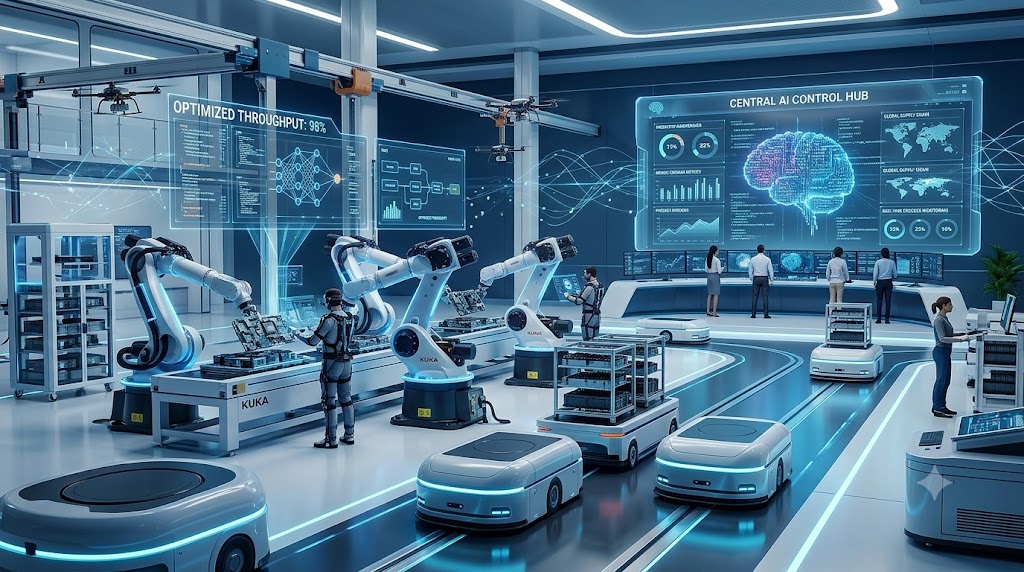
1.What is AI & Automation? Everything You Need to Know in 2026
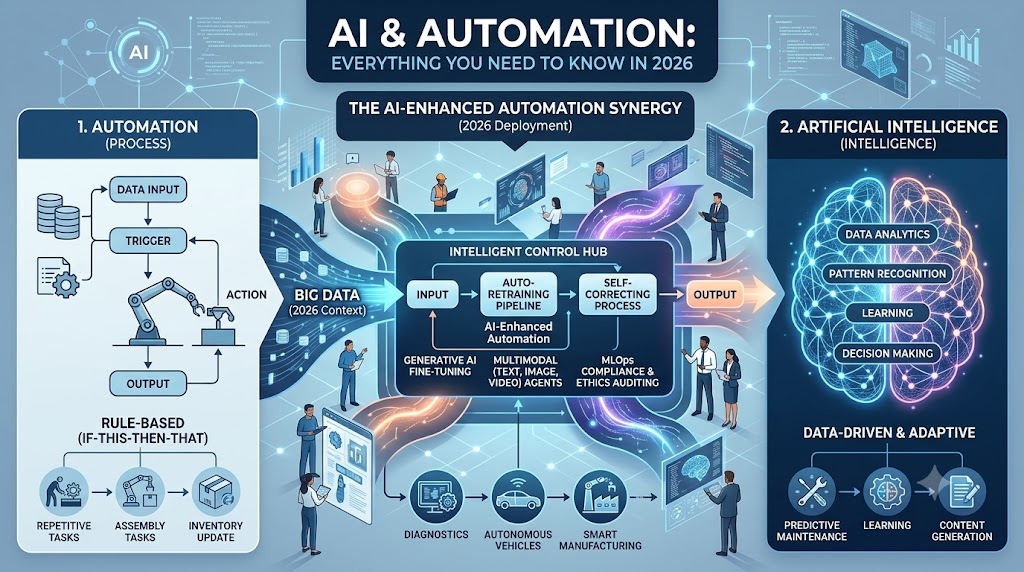
AI (Artificial Intelligence) is the ability of machines to mimic human cognition—learning, reasoning, and making decisions. Automation is the use of programmed rules to execute repetitive tasks. In 2026, AI Automation merges these concepts, allowing systems to autonomously plan, adapt, and execute complex workflows without human intervention
2.AI & Automation Explained: Benefits, Uses, Tools & Future
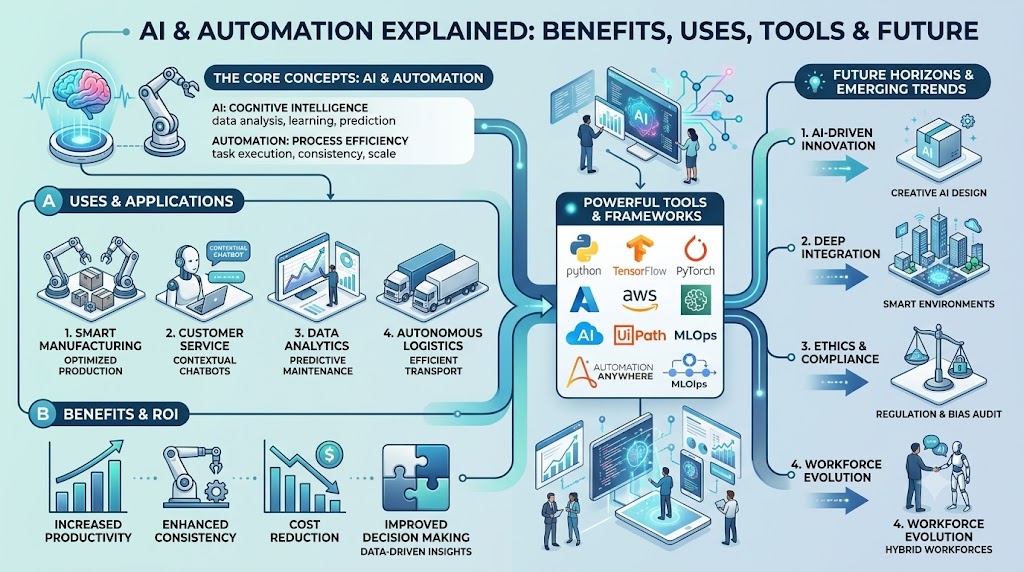
AI and automation combine robotic processes with machine learning to handle complex, repetitive tasks without human intervention. Automation follows fixed instructions, while AI learns from data and adapts to changing conditions. Together, they cut operational costs, reduce manual errors, and free workers for strategic tasks.
Core Benefits
- Increased Efficiency: Systems operate 24/7 without fatigue, speeding up workflows like document processing and customer service.
- Improved Accuracy: Reduces human errors by consistently following rules and flagging inconsistencies.
- Cost Reduction: Minimizes the need for manual oversight, overtime, and rework.
- Scalability: Handles growing volumes of tasks without requiring a proportional increase in human resources.
- Enhanced Experience: Provides customers with real-time, personalized interactions and shortens response times.
Common Uses
- Customer Support: Deploying AI-powered chatbots to answer 24/7 inquiries and resolve standard issues.
- Intelligent Document Processing: Utilizing natural language processing to extract, classify, and process invoices, contracts, and forms.
- Sales & Marketing: Automating lead scoring, CRM updates, and targeted outreach.
- Logistics & Manufacturing: Automating inventory tracking, demand forecasting, and route optimization.
Popular Tools
- Workflow Builders: Platforms like Zapier, Make, and n8n act as the command center to connect different apps.
- AI Models: Services like OpenAI ChatGPT and Anthropic Claude are integrated to make dynamic decisions within automated workflows.
- Intelligent Document Processing (IDP): Tools like ABBYY parse unstructured documents into structured data
3.AI & Automation in 2026: How It Works and Why It Matters
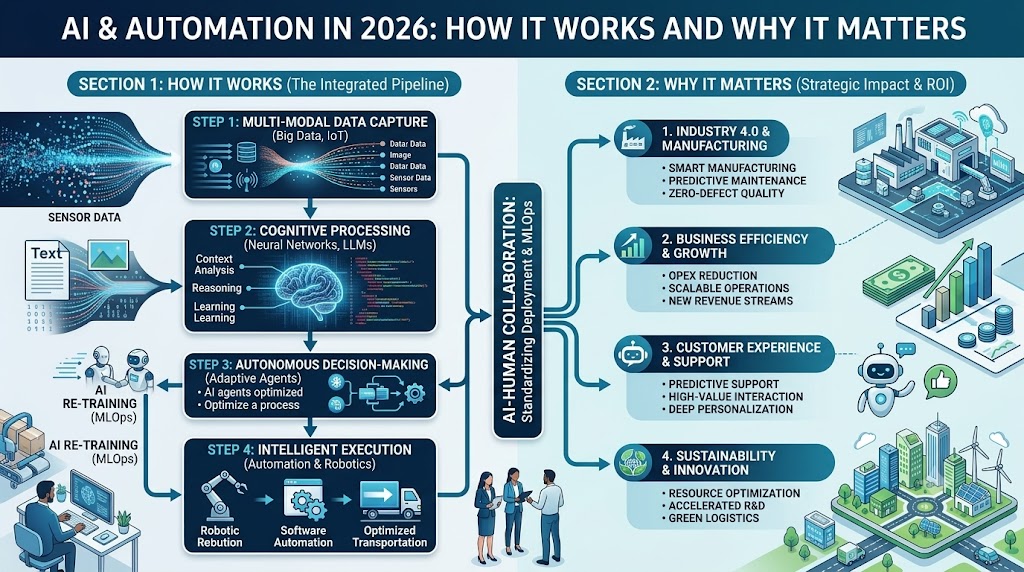
AI and automation in 2026 combine to create “agentic AI” systems that don’t just chat, but autonomously plan, execute multi-step tasks across enterprise software, and learn. This shift matters because it allows organizations to scale operations without proportional headcount increases, vastly reducing cycle times for unstructured data processing.
How It Works: From Rules to Agents
The core of modern AI automation relies on a spectrum spanning from traditional rule-based workflows to fully connected, multi-agent systems.
- Determinism: Traditional automation triggers actions based on hardcoded rules (e.g., if a support ticket is labeled “Refund”, assign it to the billing queue).
- Cognitive Understanding: AI acts as a connective tissue layer, interpreting unstructured inputs like free-text emails, messy PDFs, or audio, and normalizing them before they enter ERP or CRM systems.
- Agentic Workflows: In 2026, autonomous systems break complex user requests into smaller components, delegating tasks to specialized AI modules that act, verify outputs, and collaborate together without constant human oversight
4.Artificial Intelligence & Automation: A Complete Guide for Beginners
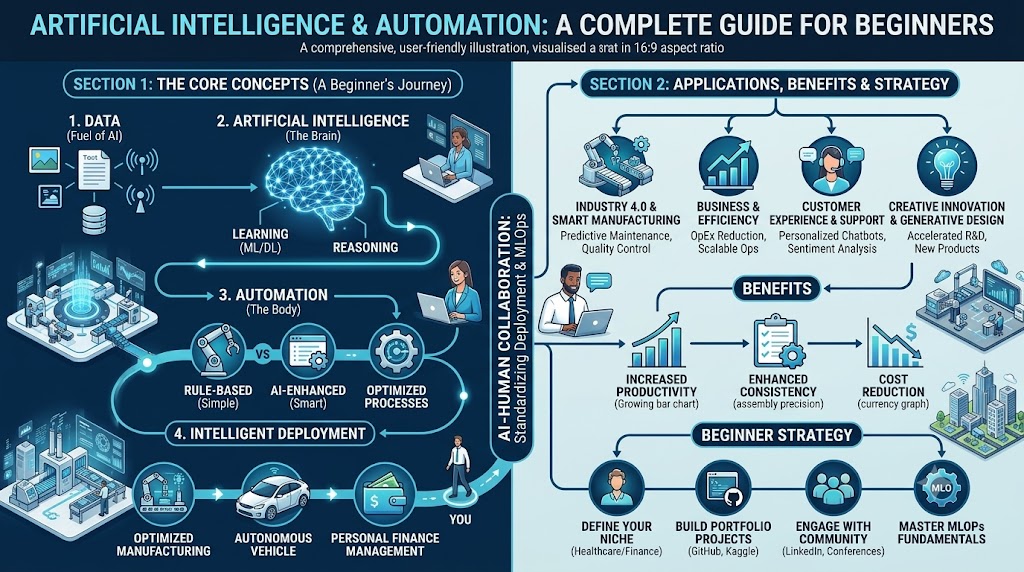
Artificial Intelligence (AI) and automation empower machines to simulate human intelligence and handle repetitive, data-heavy tasks. By linking rules-based workflows with AI logic, anyone can build systems to summarize documents, route emails, and manage data without writing a single line of code.
Core Concepts
- Automation: The use of software or robotics to reduce human labor in rule-based, repetitive workflows (e.g., payroll processing, sorting files).
- Artificial Intelligence (AI): A broader field of computer science focused on building systems capable of performing tasks that typically require human intelligence, such as learning, reasoning, and understanding language.
- AI Automation: Layering AI’s judgment and language comprehension over basic automation. For example, rather than just moving a file, AI can read the file’s contents, extract data, and generate a customized email response
5.AI Automation for Business: Benefits, Examples & Best Tools
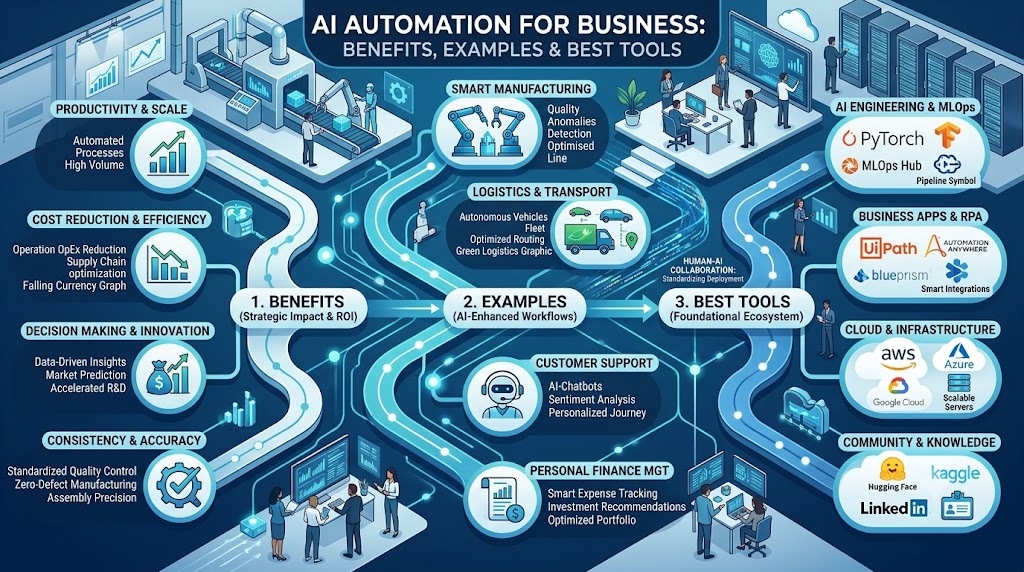
AI automation combines artificial intelligence with rule-based systems to execute tasks, process unstructured data, and handle multi-step workflows without human intervention. It provides critical benefits like slashing operational costs, eliminating manual data errors, boosting employee productivity, and delivering 24/7 personalized customer service.
Proven Business Examples
- Customer Support: AI chatbots instantly resolve common inquiries and route complex issues to human agents.
- Document Processing: Intelligent tools extract data from invoices and contracts, accelerating billing and compliance checks.
- HR and Recruitment: Algorithms screen resumes, match candidates to job descriptions, and handle initial interviews
6.How AI & Automation Are Transforming Jobs and Businesses in 2026
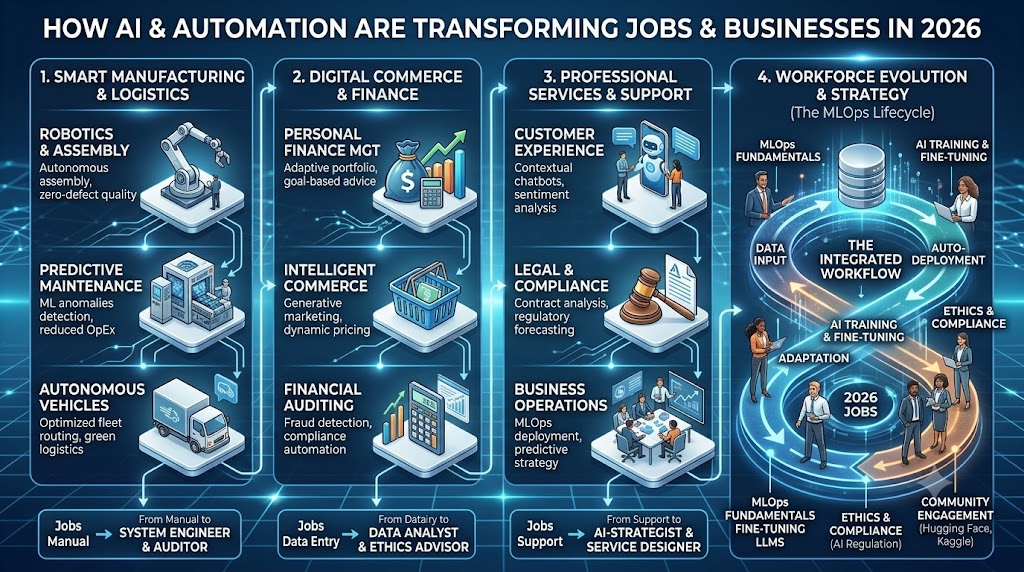
In 2026, AI and automation are transitioning from simple generative text tools to agentic AI, which proactively executes multi-step workflows without human intervention. Businesses are adopting hyperautomation to orchestrate operations, while the workforce is shifting from routine tasks to high-level strategy and oversight.
How AI is Transforming Businesses
- Intelligent Orchestration: Instead of using isolated tools, companies utilize unified platforms to manage entire operational pipelines across departments.
- Hyper-Personalization: AI systems analyze behavioral patterns in real-time to tailor marketing, financial services, and e-commerce experiences instantly.
- End-to-End Automation: Routine functions—such as lead management, invoice processing, and HR recruitment—are completely automated, drastically reducing administrative costs.
- Sector-Specific Innovations: Specialized AI is accelerating operations in healthcare (e.g., automated drug discovery), logistics (e.g., predictive supply chains), and finance (e.g., real-time fraud detection)
What is AI & Automation?
AI & Automation is the combination of Artificial Intelligence and automated processes that perform tasks with minimal human intervention, improving speed, accuracy, and productivity.
2. What is the difference between AI and Automation?
Automation follows predefined rules to complete repetitive tasks, while AI can learn from data, recognize patterns, and make intelligent decisions.
3. How does AI Automation work?
AI automation uses machine learning, natural language processing (NLP), computer vision, and workflow automation tools to automate tasks and improve decision-making.
4. What are the benefits of AI & Automation?
Key benefits include:
Increased productivity
Reduced operational costs
Faster decision-making
Improved accuracy
Better customer experience
24/7 business operations
5. Where is AI & Automation used?
AI & Automation are widely used in:
Digital Marketing
Healthcare
Banking & Finance
E-commerce
Manufacturing
Education
Customer Support
Human Resources
6. Which are the best AI automation tools in 2026?
Popular tools include:
ChatGPT
Google Gemini
Microsoft Copilot
Zapier
Make (formerly Integromat)
n8n
Claude
Notion AI
7. Can beginners learn AI & Automation?
Yes. Beginners can start by learning AI basics, prompt engineering, workflow automation, and no-code automation tools before moving to advanced AI technologies.