
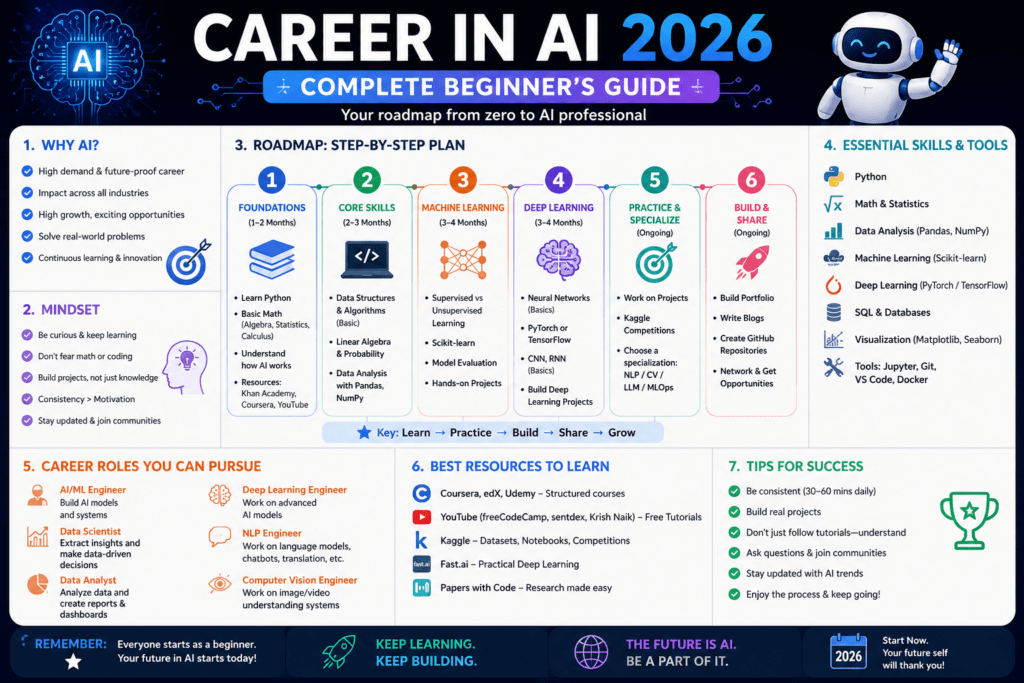
1.Career in AI 2026

A career in AI for 2026 centers on building AI agents, integrating APIs (like OpenAI and Hugging Face), and MLOps deployment. Beginners should master Python and core machine learning fundamentals, bypassing heavy math-first curricula in favor of practical, real-world portfolio projects
2.How to Start a Career in Artificial Intelligence in 2026
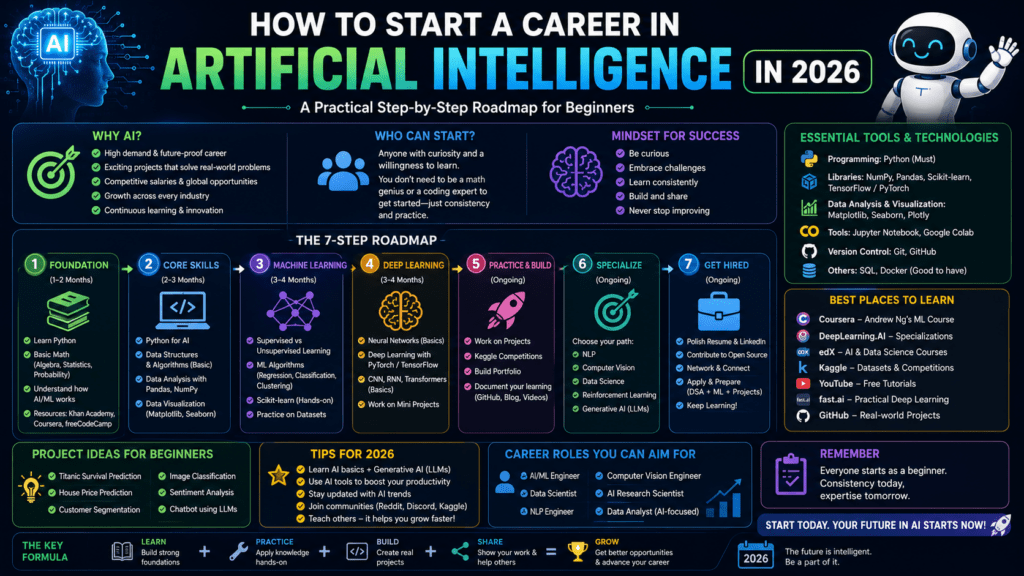
Starting a career in AI in 2026 requires mastering Python, core math (linear algebra/statistics), and machine learning. Specialize by learning frameworks like PyTorch or TensorFlow, and build a portfolio of hands-on projects to prove your applied skills to employers.
1. Build Foundational Skills
Before diving into advanced AI, you need a solid grasp of the core pillars:
- Programming: Python is the undisputed industry standard. Learn to use essential libraries like NumPy, Pandas, and Scikit-Learn.
- Mathematics: You need a fundamental understanding of linear algebra, probability, and statistics to grasp how AI models learn and make decisions.
- SQL: Data manipulation and retrieval are vital, as AI systems rely heavily on robust datasets.
2. Learn Machine Learning & Deep Learning
Transition from basic data science to building intelligent algorithms:
- Traditional ML: Understand regression, classification, decision trees, and clustering.
- Deep Learning & Neural Networks: Move to complex models using frameworks like TensorFlow or PyTorch.
- Generative AI: Familiarize yourself with Large Language Models (LLMs), prompt engineering, and utilizing major APIs (e.g., OpenAI, Anthropic, Gemini) to build applications
3.Best AI Career Options After 12th, Graduation & College
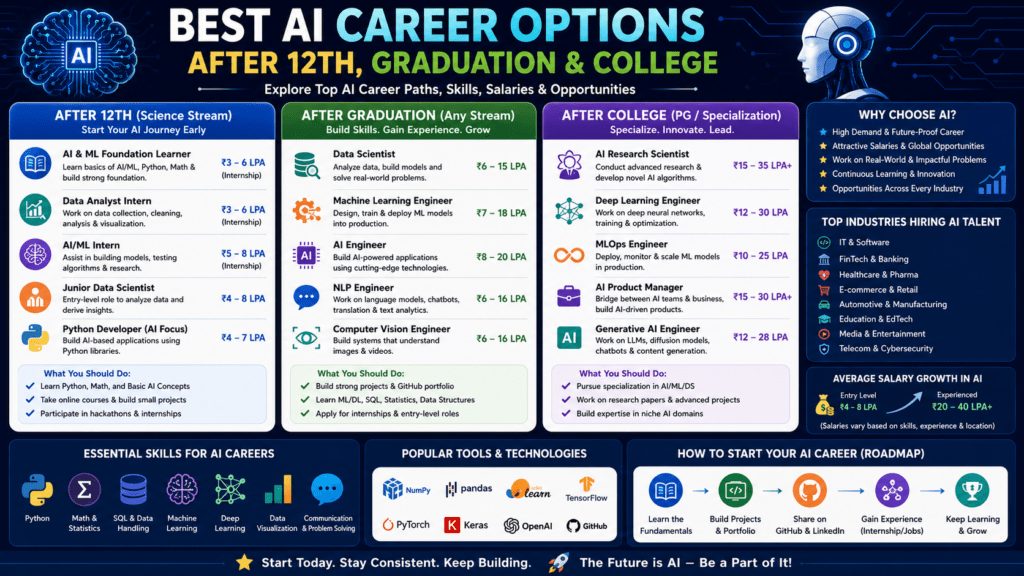
The best AI careers include roles like AI Engineer, Machine Learning (ML) Engineer, Data Scientist, and NLP Engineer. These top-paying, high-demand positions are accessible through tailored paths, whether you are starting fresh after 12th, seeking a degree, or a college graduate looking to upskill.
After 12th
For students just finishing school, the strongest path is pursuing a four-year B.Tech in CSE with a specialization in AI/ML or Robotics. If you do not have a science background, BCA (Bachelor of Computer Applications) with an AI/ML specialization offers a great three-year, job-ready alternative.
- Top roles: Junior Data Analyst, Junior AI Developer, Automation Specialist.
- Relevant reading: Review program structures in the stream-wise selfword AI Course
After Graduation
If you have just earned an undergraduate degree, a Master’s program like an M.Tech or specialized postgraduate diplomas will help you target higher-level positions in research and development. Graduates with strong math or analytical backgrounds can easily pivot into data-heavy or business-focused roles.
- Top roles: AI/ML Engineer, Data Scientist, AI Product Manager.
Post-College / Working Professionals
Graduates already in the workforce can transition into artificial intelligence without returning to university by mastering modern AI frameworks, prompt engineering, and deep learning through targeted boot camps or online certifications.
- Top roles: NLP (Natural Language Processing) Engineer, Computer Vision Engineer, MLOps Specialist.
- Relevant options: Compare structured pathways using the selfword
4.Top AI Jobs in 2026: Salary, Skills & Growth
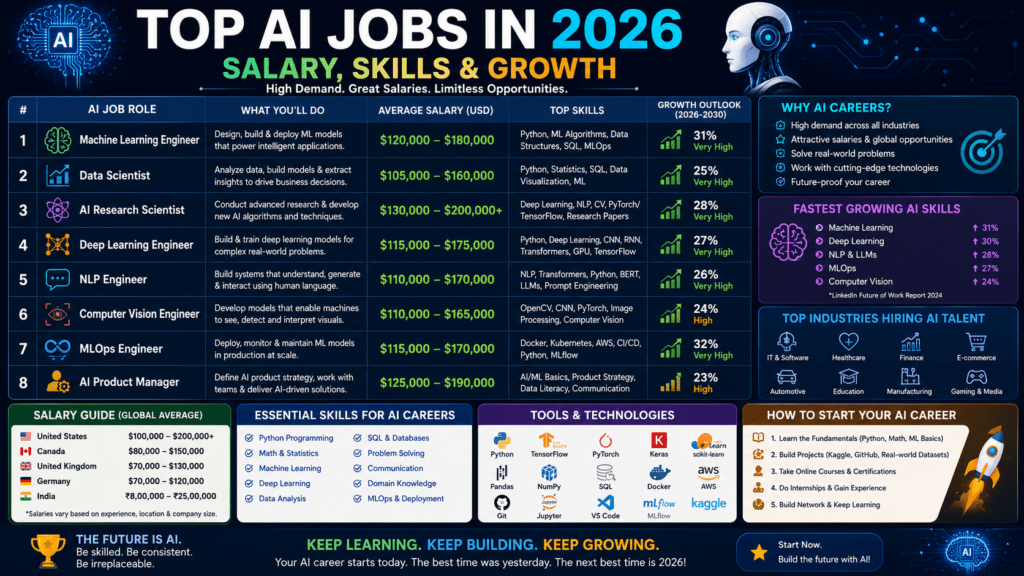
In 2026, the AI job market is dominated by roles like AI/ML Engineer, Generative AI Specialist, and MLOps Engineer. Top Indian and global employers require verifiable skills like PyTorch and LangChain rather than just traditional degrees. Mid-level salaries in India range from ₹12–25+ Lakhs Per Annum (LPA), scaling past ₹40+ LPA for senior roles.
Top AI roles are driven by massive hiring demands across major product and IT consulting firms, bringing the following opportunities:
Top AI Roles and Salaries
- AI/ML Engineer: The fastest-growing tech role. Focuses on designing, building, and deploying AI systems.
- Salary: ₹8–25 LPA in India; $175K–$250K+ in the USA.
- Generative AI Specialist / Engineer: Connects private enterprise data to Large Language Models (LLMs).
- Salary: ₹15–30+ LPA in India; $180K–$280K in the USA.
- MLOps Engineer: Maintains and scales AI models in production environments.
- Salary: ₹9–18 LPA for early-career to ₹30–50 LPA for senior roles in India.
- Data Scientist: Analyzes complex datasets to drive business decisions.
- Salary: ₹8–30+ LPA in India; $130K–$200K+ globally.
In-Demand Core Skills
- Programming: Advanced Python, SQL, and Java/C++ for integrating models.
- Frameworks & Tools: PyTorch, TensorFlow, LangChain, and RAG (Retrieval-Augmented Generation).
- Infrastructure: Docker, Kubernetes, and major cloud providers (AWS, Azure, GCP).
- Specializations: Domain-specific ML in Finance (time-series, anomaly detection) or Healthcare (FHIR, predictive diagnostics)
5.Artificial Intelligence Career Roadmap for Beginners
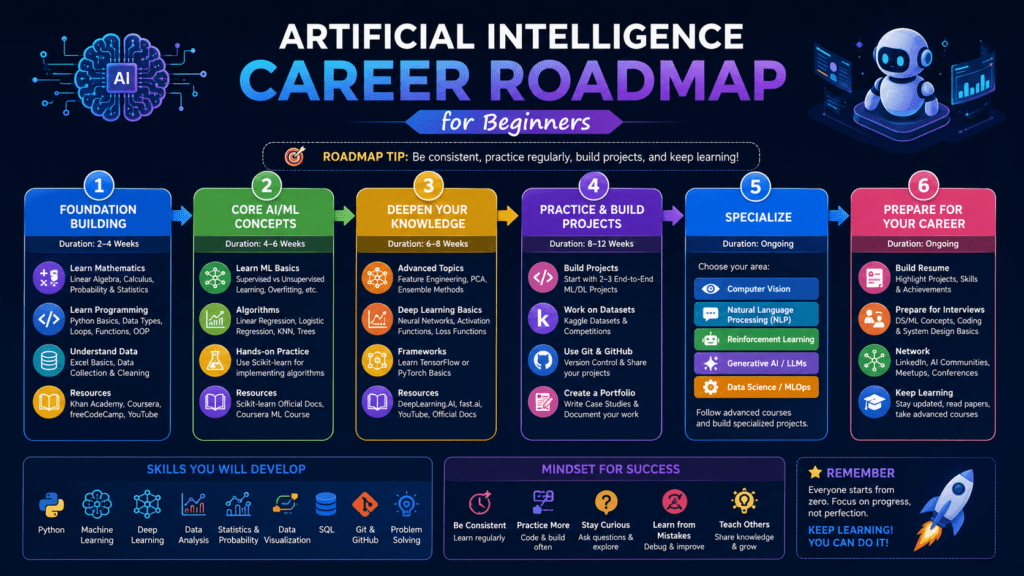
Starting an AI career requires building a strong foundation in data and coding before moving to specialized AI systems. Dedicate 6 to 12 months to mastering Python, statistics, and machine learning basics before building real-world projects like chatbots or prediction models.
Here is a step-by-step roadmap to guide your transition into AI:
Phase 1: Foundational Skills (Months 1–3)
Before using complex AI, master the basics of programming and mathematics.
- Learn Python: Focus on variables, loops, functions, and standard libraries.
- Mathematics & Statistics: Grasp foundational linear algebra, calculus, and probability distributions.
- Software Tools: Learn to use Git and GitHub for version control and the command line.
Phase 2: Data & Machine Learning (Months 4–6)
AI is primarily about recognizing patterns in data. Start preparing and analyzing datasets.
- Data Manipulation: Master Python libraries like Pandas and NumPy for data cleaning and manipulation.
- Core Algorithms: Understand algorithms such as linear regression, decision trees, and clustering.
- Practical Projects: Build simple quantitative models, like a house-price or salary predictor.
Phase 3: Generative AI & Orchestration (Months 7–9)
Transition into modern AI by working with Large Language Models (LLMs) and Generative AI frameworks.
- Prompt Engineering: Learn to effectively instruct and guide AI models.
- Retrieval-Augmented Generation (RAG): Understand how to use vector databases and external memory to pull relevant data into AI systems.
- APIs & Chaining: Connect AI models to other software tools and data sources to create usable AI applications.
Phase 4: Specialization & Portfolio (Months 10–12)
Focus on a specific AI career path and build a portfolio to showcase your abilities to employers.
- Choose a Track: Do you want to be a Machine Learning Engineer (building algorithms), an AI Engineer (building AI products), or a Data Scientist (analyzing business data)?
- Build Real Projects: Build production-ready AI systems or contribute to open-source initiatives rather than just following tutorials.
- Network & Apply: Optimize your LinkedIn and share the progress of your projects to attract recruiters
6.AI Career Guide for Students and Working Professionals
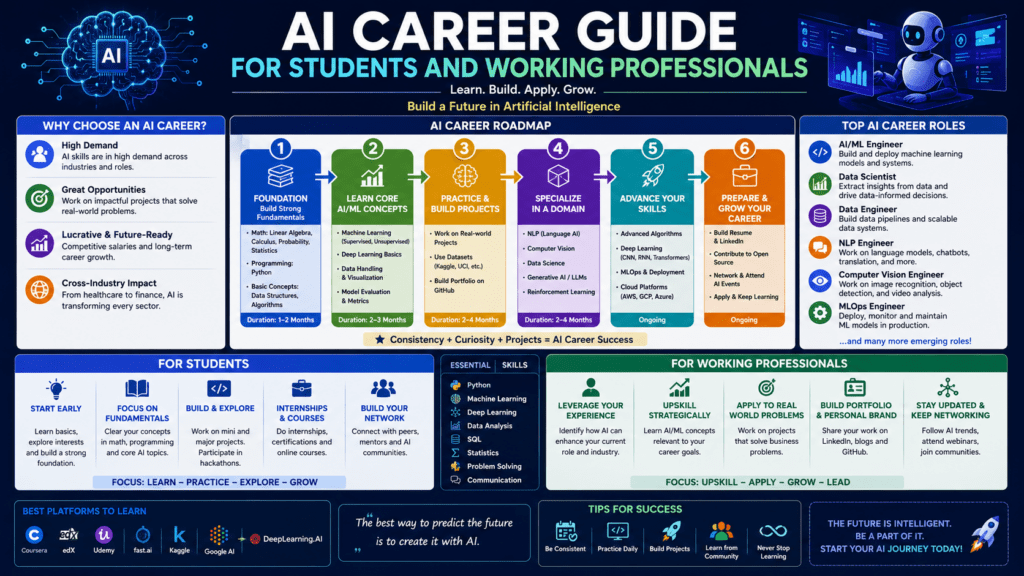
Launching an AI career requires building foundational skills in Python, SQL, and statistics, followed by specializations like Machine Learning (ML) or Natural Language Processing (NLP). Students should focus on degrees in Computer Science or Data Science, while working professionals can pivot by taking specialized certifications and applying AI to their current industry workflows.
AI Roadmap for Students
Students should focus on building a strong academic and practical foundation to enter the AI field.
- Core Studies: Master linear algebra, probability, and algorithms. Computer Science and Data Science are the most direct academic paths.
- Programming & Libraries: Learn to code in Python and become familiar with essential data and ML libraries like Pandas, NumPy, and PyTorch.
- Hands-On Experience: Build mini-projects, contribute to open-source code, and secure internships to develop a practical portfolio.
- Certifications: Boost your resume early with recognized programs like the Google AI Professional Certificate on Coursera.
AI Roadmap for Working Professionals
Professionals can transition into AI by mapping their existing domain expertise to emerging AI roles.
- Upskilling: Take structured, project-based courses from top platforms to gain fluency in AI/ML tools.
- Domain Integration: Start by automating tasks and analyzing data in your current job using Prompt Engineering and Generative AI tools.
- Targeted Roles: Consider shifting into roles like AI Consultant, Data Analyst, or Machine Learning Engineer by acquiring certifications from providers like Coursera AI Specializations
7.AI vs Digital Marketing: Which Career is Better in 2026?
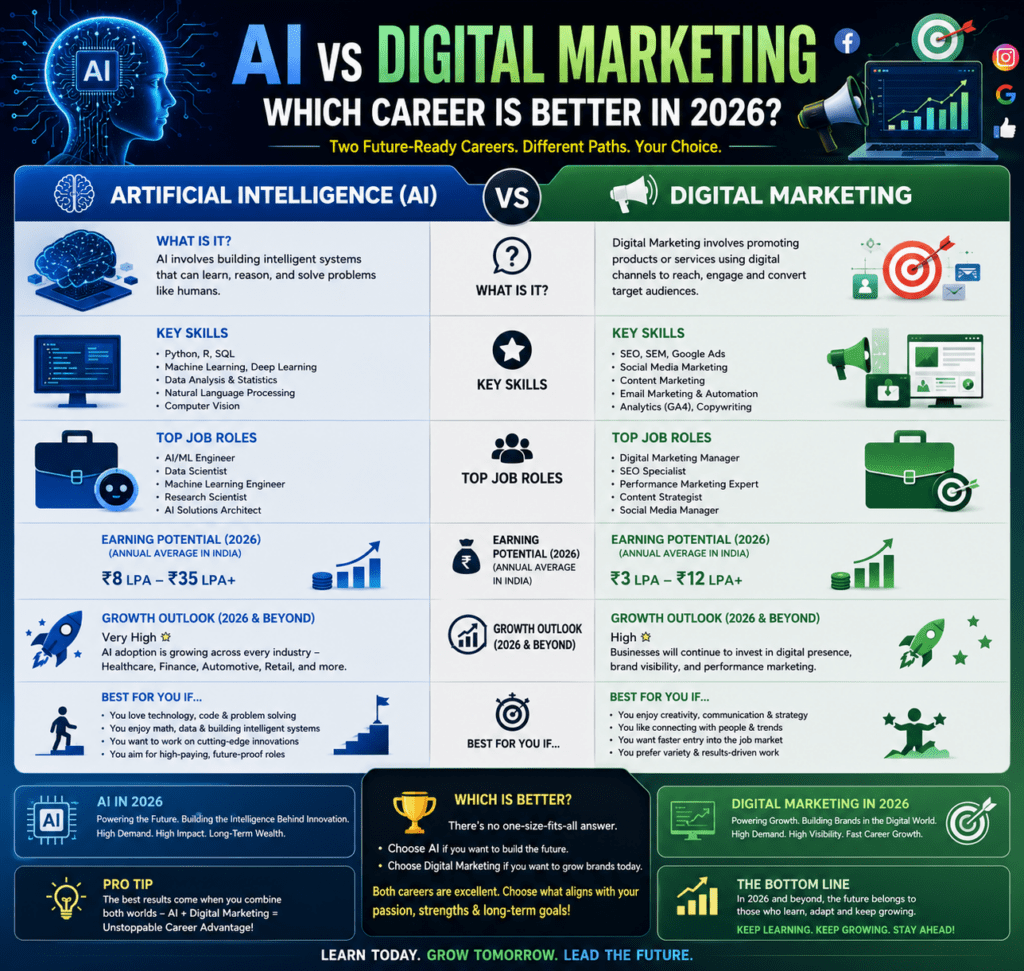
In 2026, the best career path is neither AI nor digital marketing in isolation, but AI-Powered Digital Marketing. Rather than killing the profession, AI has raised the skill floor, with AI-skilled marketers earning significantly higher starting salaries. AI handles repetitive tasks while humans drive strategy.
Why AI-Powered Digital Marketing Wins
- New High-Demand Roles: The industry is pivoting toward roles like AI-Powered Performance Marketer, Content Intelligence Strategist, and Generative Engine Optimization (GEO) Specialist.
- Scalable Earning Potential: Marketers who master AI can automate campaigns and scale lead generation, allowing remote professionals in India to serve global markets
- Better Job Security: Pure AI development is concentrated heavily in tech companies. In contrast, digital marketing jobs exist across all industries, business sizes, and regions.
Core AI Skills to Learn
To future-proof your career and stay competitive, focus on mastering these specific tools and capabilities:
- Prompt Engineering: Structuring instructions for LLMs like ChatGPT and Claude to draft ad copy and strategy outlines.
- Predictive Analytics: Using AI within platforms like Google Analytics 4 (GA4) to analyze consumer behavior and optimize ad spends.
- Automation Architectures: Building “hands-off” lead generation funnels using tools like HubSpot AI
8.How to Become an AI Engineer in 2026 (Step-by-Step)
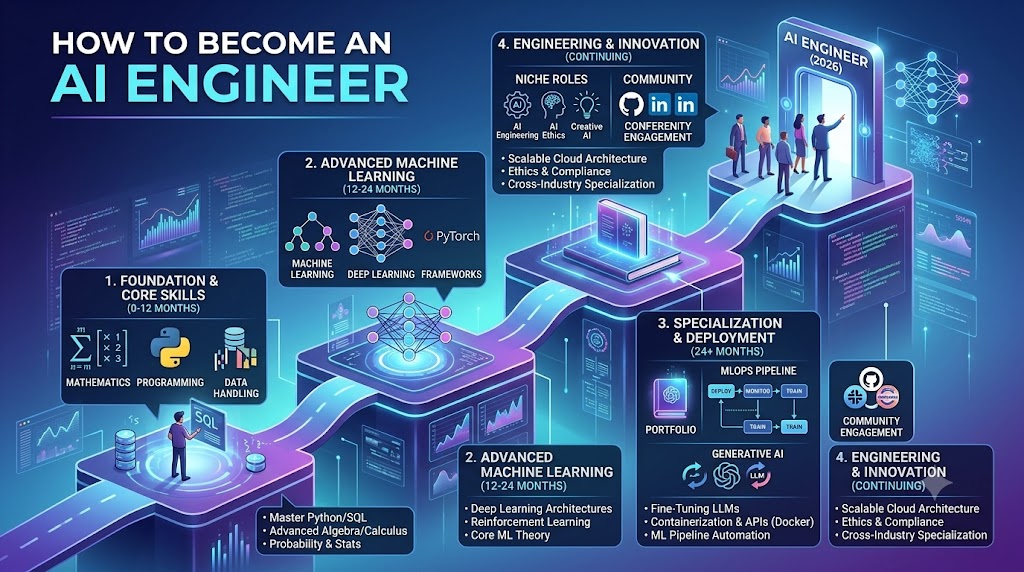
Becoming an AI Engineer in 2026 focuses on building production-ready AI applications using existing models rather than building models from scratch. Master Python, software engineering fundamentals, Large Language Model (LLM) APIs, Retrieval-Augmented Generation (RAG), and agentic workflows to build and deploy real-world AI systems.
Here is the step-by-step roadmap to get job-ready:
Step 1: Programming & Developer Foundations
Focus on software engineering, as modern AI engineering is fundamentally “software engineering with AI components bolted on
- Python: Master the language, basic data structures, Object-Oriented Programming (OOP), and asynchronous programming.
- Software Tools: Learn Git/GitHub for version control, basic SQL for querying, and how to build/consume REST APIs using FastAPI or Flask.
Step 2: LLM & Generative AI Basics
Understand how to interact with frontier models (like OpenAI, Claude, Gemini) and extract the best performance.
- Concepts: Learn how tokenization, context windows, temperature, and function calling work.
- Frameworks: Start building small projects utilizing tools like LangChain or LlamaIndex to structure AI outputs.
Step 3: RAG & Vector Databases
The most immediate industry demand is connecting AI models to private or proprietary data securely.
- Core Concepts: Learn text chunking strategies, embeddings, and hybrid search.
- Vector Databases: Get familiar with tools such as Pinecone, Chroma, Qdrant, or PGVector.
Step 4: AI Agents
Move beyond simple chatbots to building adaptable, stateful agents that can reason, plan, and execute multi-step tasks.
- Concepts: Learn state management, human-in-the-loop workflows, and memory systems.
- Evals & Observability: Learn how to test AI application latency, cost, and output quality using tools like LangSmith.
Step 5: Deployment & Production (MLOps)
Proving you can put AI apps into production is what gets you hired.
- Containerization: Learn Docker to package your AI applications consistently.
- Cloud: Host your APIs on platforms like AWS, Google Cloud, or Render.
Step 6: Build a Portfolio
Do not rely entirely on certificates; build and deploy live, user-facing applications to showcase your skills.
- Project Ideas: Build a structured document extractor, a local RAG assistant, and a multi-step, tool-using AI agent
1. What is Artificial Intelligence (AI)?
Artificial Intelligence (AI) is a technology that enables computers and machines to perform tasks that normally require human intelligence, such as learning, problem-solving, content generation, and decision-making.
2. Is AI a good career in 2026?
Yes. AI is one of the fastest-growing career fields in 2026, offering high-paying jobs, global opportunities, and strong long-term demand across industries.
3. What skills are required for an AI career?
Some essential AI skills include:
Prompt Engineering
Machine Learning
Python Programming
Data Analysis
Deep Learning
Generative AI
NLP (Natural Language Processing)
AI Tools (ChatGPT, Gemini, Claude, Copilot)
4. How can beginners start a career in AI?
Beginners can start by learning AI fundamentals, Python, prompt engineering, machine learning basics, building AI projects, and creating a professional portfolio.
5. What are the best AI jobs in 2026?
Popular AI careers include:
AI Engineer
Machine Learning Engineer
Data Scientist
Prompt Engineer
AI Automation Specialist
AI Content Creator
AI Product Manager
Computer Vision Engineer
NLP Engineer
AI Research Scientist