
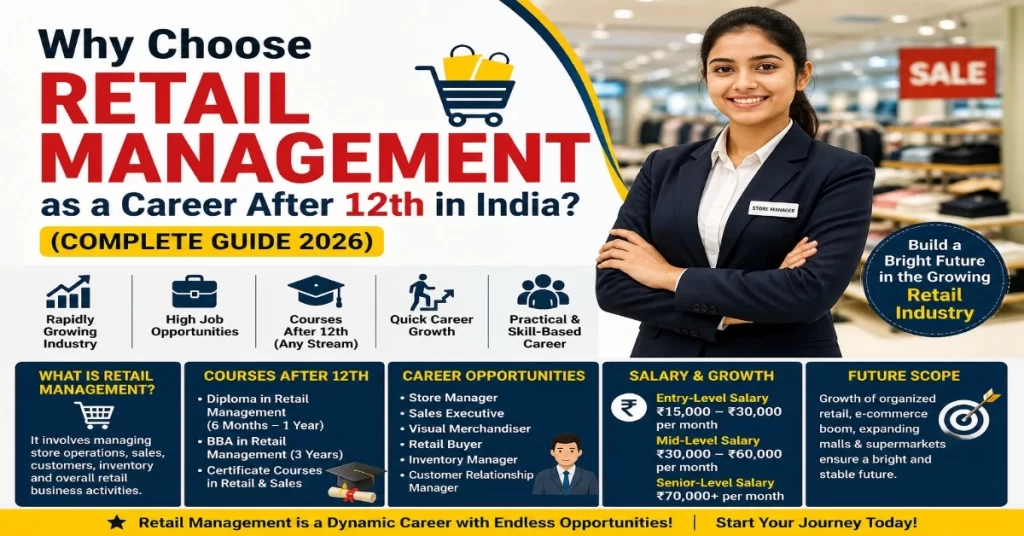
1. Introduction
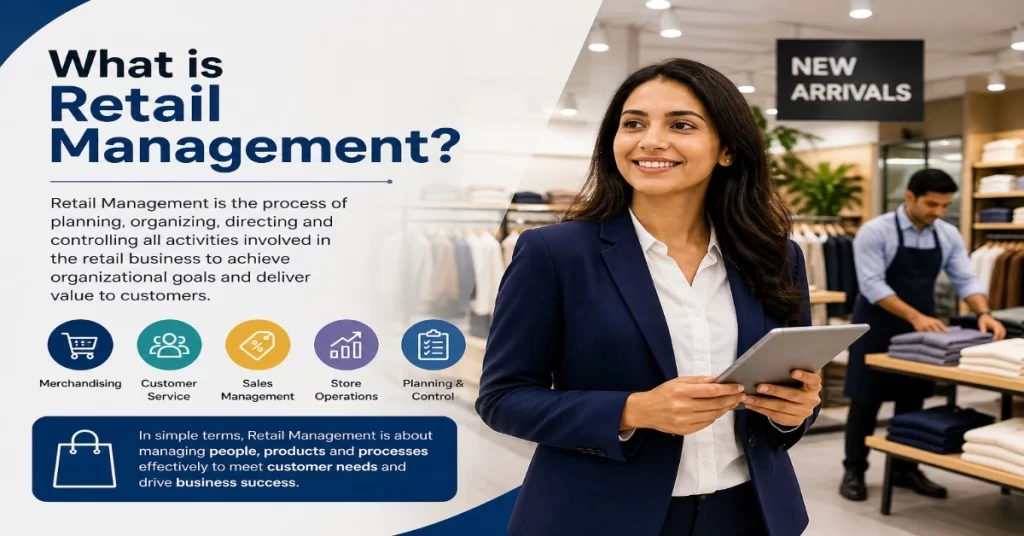
⦁ What is Retail Management? Retail management is the comprehensive process of planning, organizing, and overseeing all operations within a retail store—physical or digital—to sell products to consumers. It focuses on enhancing the customer experience, optimizing inventory, improving store layout, and managing staff to maximize sales and profitability.
⦁ Why students choose retail management after 12th Students choose to pursue retail management after their 12th-grade education because it offers a fast-tracked, dynamic career pathway with high demand, diverse job roles, and quick professional growth. The sector combines people skills with business strategy, making it an attractive option for those looking for practical, transferable skills.
2. Why Retail Management is a Good Career Option
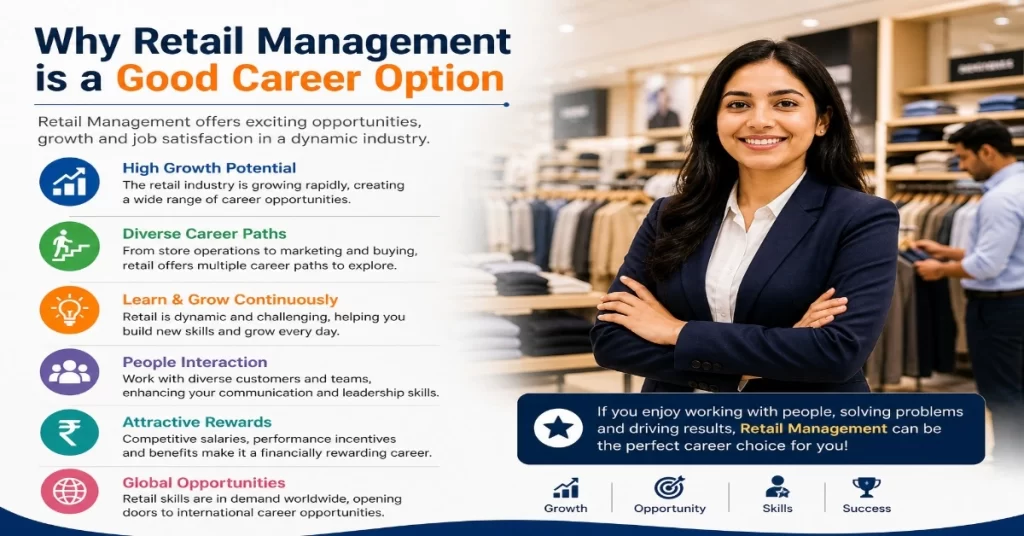
⦁ Growing retail industry in India India’s $1.06 trillion retail sector is projected to reach $1.93 trillion by 2030, growing at a 10% CAGR. Driven by rising income, urbanization, and digital adoption, the industry is transitioning towards organized retail and omnichannel models. Key trends include the rapid expansion of quick commerce, premiumisation, and a surge in consumption from Tier II and III cities.
⦁ High job opportunities High-opportunity job fields in 2026 are primarily driven by technology, data, and digital transformation, offering substantial salaries and rapid career growth in India.
⦁ Career growth and salary benefits Career growth and salary benefits are closely intertwined, with proactive career development usually resulting in significant long-term financial rewards. While an immediate high salary is attractive, prioritizing career growth—such as gaining new skills, taking on more responsibility, or switching to higher-growth roles—often leads to better long-term financial stability and job satisfaction.
3. Retail Management Courses After 12th
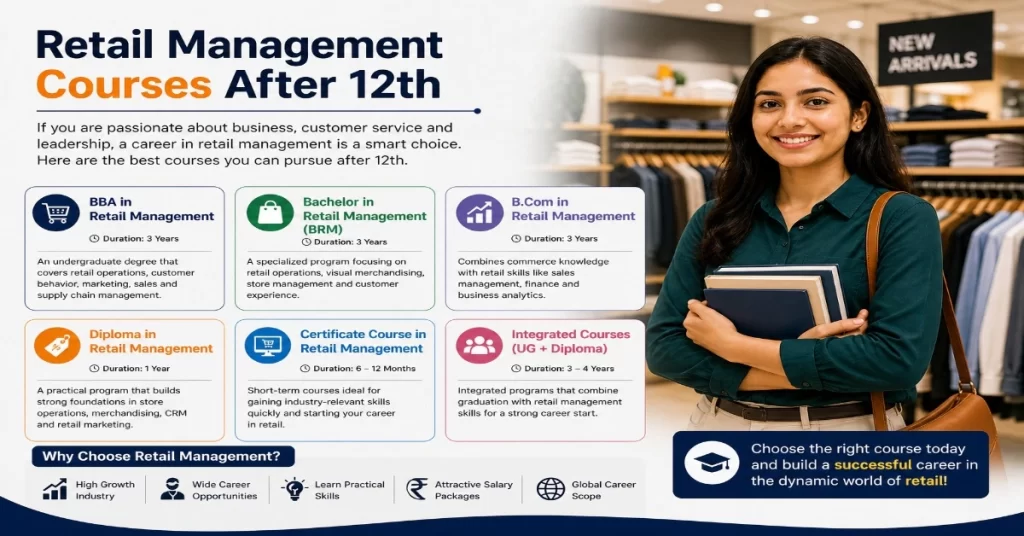
⦁ Diploma courses Diploma courses are specialized, short-term academic or vocational programs designed to provide practical skills and knowledge in specific fields, typically lasting 1 to 3 years. They are excellent for entering the workforce quickly, often serving as a faster alternative to traditional degree programs, with many options available after 10th or 12th grade.
⦁ Degree programs Degree programs cover a wide range of academic and professional fields, structured as undergraduate (Bachelor’s) or postgraduate (Master’s/PhD) studies. In 2026, top fields include Artificial Intelligence, Data Science, Management, and professional degrees like Law and Medicine
⦁ Certification courses High-demand certification courses in 2026 cover fields such as technology, data analytics, project management, and specialized professional skills. These courses are available through various online platforms and institutions, often offering flexible, self-paced learning.
4. Skills Required for Retail Management
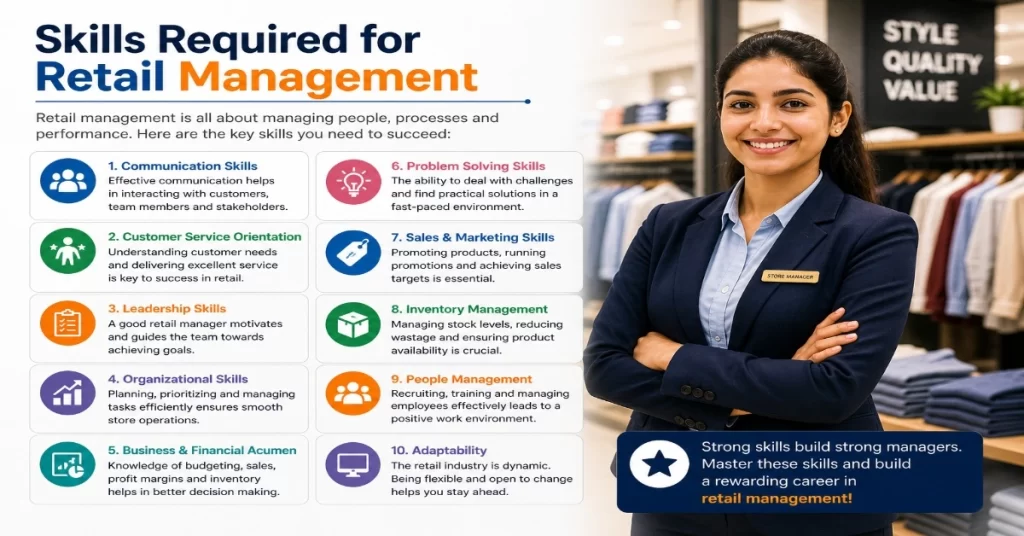
⦁ Communication skills Effective communication skills involve conveying and receiving information clearly through verbal, non-verbal, written, and active listening methods. Key skills include active listening, empathy, conciseness, and open body language. These skills improve workplace collaboration, personal relationships, and professional development.
⦁ Leadership Leadership is the ability to influence, inspire, and guide individuals or teams toward achieving a common goal, based on social influence rather than just authority. It involves setting direction, fostering alignment, and demonstrating key virtues like intelligence, trustworthiness, and courage. Effective leaders, as defined by studies in adapt to change, empower their teams, and act with integrity to bring out the best in others.
⦁ Customer handling Customer handling involves the strategies used to interact with customers, address concerns, and ensure satisfaction, which helps build loyalty and improve reputation.
⦁ Sales & marketing knowledge Sales and marketing are distinct yet interdependent functions designed to drive revenue and growth. Marketing focuses on generating awareness, interest, and leads through brand management and advertising, while sales focuses on directly engaging potential customers to convert them into paying clients.
5. Career Opportunities in Retail Management
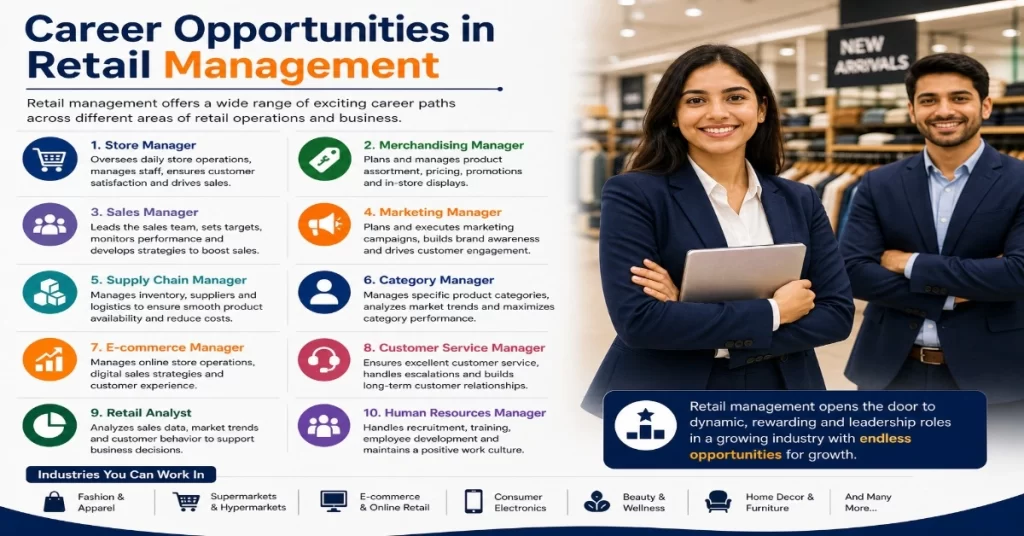
⦁ Store Manager A Store Manager is responsible for overseeing the daily operations, profitability, and staff of a retail store. Key duties include managing inventory, improving customer experience, driving sales targets, implementing visual merchandising, and handling staff training. They often serve as key-holders responsible for safety, opening/closing, and operational compliance.
⦁ Retail Executive A Retail Executive is a professional responsible for driving store sales, enhancing customer experience, and overseeing daily operational tasks within a retail environment. They act as the link between corporate strategy and ground-level execution, ensuring that sales targets are met and brand standards are maintained.
⦁ Sales Manager A Sales Manager drives revenue by leading a sales team, setting targets, and developing strategies to increase market share. They are responsible for recruiting, training, and motivating staff, managing customer relationships, and analyzing performance data to meet company goals
⦁ Merchandising Manager A Merchandising Manager is a strategic professional responsible for maximizing sales and profitability by planning, buying, and displaying products effectively. They bridge the gap between product development/sourcing and the final sale, ensuring the right products are available at the right time in the right location.
⦁ Brand Manager A Brand Manager is a marketing professional responsible for developing, protecting, and nurturing an organization’s brand identity to ensure consistency, relevance, and authenticity across all channels. They act as the “guardian” of the brand, managing everything from visual identity to product messaging, with the ultimate goal of driving customer loyalty and increasing sales.
6. Salary in Retail Management in India
⦁ Fresher salary As of May 2026, fresher salaries in India vary significantly based on industry, location, and skills, with an overall average falling between ₹3 LPA and ₹4.5 LPA
⦁ Experienced professional salary Based on 2026 data, the salary for an experienced professional in India varies significantly based on years of experience, industry, and location, ranging from ₹5.7 Lakhs to over ₹50 Lakhs per year for senior roles
7. Top Companies Hiring Retail Management Students

⦁ Reliance Retail Reliance Retail is India’s largest, fastest-growing, and most profitable retailer, operating over 18,000 stores across grocery, electronics, and fashion. A subsidiary of Reliance Industries, it serves nearly 249 million registered customers, with a significant presence in both physical stores and e-commerce through JioMart.
⦁ Lifestyle Lifestyle refers to the characteristic way of living of an individual, group, or culture, encompassing their behaviors, attitudes, interests, and habits.
- Shoppers Stop
- Amazon
- Flipkart
8. Future Scope of Retail Management in India

⦁ E-commerce growth The global e-commerce market is experiencing rapid expansion, projected to reach US \(\$155.98\) trillion by 2033, driven by increasing smartphone adoption and digital payments. Key trends include the growth of social commerce, AI integration, and rapid acceleration in emerging markets like India, which is expected to reach \(550\) billion by 2035.
⦁ Shopping mall expansion India’s top seven cities will add 16.6 million sq. ft. of prime Grade A retail space by the end of 2026, driven by high demand for quality shopping experiences. Hyderabad and Delhi-NCR lead this expansion, commanding 65% of the new supply. Over 42.5 million sq. ft. is planned across India through 2029
⦁ International retail brands The landscape of international retail brands is dominated by large multinational corporations that operate across multiple continents, offering a mix of mass-market goods, groceries, and specialized fashion.
9. Conclusion

⦁ Why retail management is a smart career choice after 12th Retail management is a smart career choice after the 12th because it offers a fast-tracked, high-growth path into one of the world’s largest industries, with rapid opportunities for advancement into leadership roles. It is highly accessible for freshers, providing practical, in-demand skills in communication, sales, and operations without requiring years of prior experience.